
Article
Dedicated vs. Consolidated Long-Distance Moving in Canada: Costs, Timelines, and Trade-Offs
Compare dedicated and consolidated long-distance moving in Canada, including costs, delivery timelines, handling, and the best fit for your move.
Published
October 21, 2026
Updated
October 21, 2026
Category
moving tips
Author
MoveMate Editorial Team
Moving and relocation guidance
The MoveMate Editorial Team creates practical moving guidance based on the information customers and moving professionals need to plan clear, efficient moves across Canada.

Moving long distance across Canada involves a major logistical choice: deciding between dedicated moving and consolidated, or shared-truck, moving.
Quick answer: Dedicated long-distance moving reserves an entire truck for your household goods, providing direct transport and set delivery dates. Consolidated moving combines multiple household shipments in one long-haul trailer along major corridors, reducing costs in exchange for a delivery window that may span 7 to 21 days.
Dedicated moving is best for: Full three-bedroom or larger home moves, strict lease or closing dates, tight condo elevator bookings, and high-value shipments where minimizing handling is a priority.
Consolidated moving is best for: One- or two-bedroom apartments, partial shipments, flexible arrival schedules, and budget-conscious customers moving between major urban centres.
Ready to compare long-distance quotes?
Planning an interprovincial move across Canada? Skip the repeated calls and get pricing tailored to your inventory and delivery requirements.
Compare long-distance moving quotes with MoveMate
At-a-glance comparison: dedicated vs. consolidated moving
| Feature | Dedicated long-distance moving | Consolidated (shared-truck) moving |
|---|---|---|
| Truck space allocation | 100% exclusive trailer allocation | Compartmentalized, shared trailer space |
| Delivery schedule | Exact, scheduled arrival date | Estimated window, often 7 to 21 business days |
| Transit route | Direct point-to-point transit | Multi-stop linehaul along major corridors |
| Average cost structure | Premium pricing based on exclusive vehicle use | Lower costs through shared fuel and driver expenses |
| Interim handling | Loaded once, driven directly, and unloaded once | Loaded into separated sections with limited inventory handling |
| Optimal household size | Three-bedroom or larger homes and large office inventories | Studios, apartments, and smaller homes |
What is dedicated long-distance moving?
How dedicated long-distance moving works in Canada
Dedicated long-distance moving provides a freight vehicle and crew assigned solely to your shipment. Once the moving crew loads your items at the origin address, the vehicle is secured and driven directly to your destination address in Canada.
Key benefits of dedicated long-distance transport
- Set delivery dates: Because the truck travels directly from point A to point B, you can arrange exact pickup and delivery dates. This can reduce long stays in temporary accommodations or time spent waiting for essential furniture.
- Direct point-to-point transit: Without intermediate stops at regional logistics hubs or transfer stations, transit times are usually shorter.
- Reduced handling risk: Your belongings are loaded onto the truck once and unloaded at your destination, minimizing handling cycles and reducing potential wear or transit damage.
- Flexible capacity: Dedicated trucks can accommodate custom requirements, including oversized items, vehicles, or specialized crating.

When to choose dedicated moving services
Dedicated long-distance moving is a strong option if you are relocating a multi-bedroom home, moving on a strict corporate transfer schedule, or coordinating a narrow move-in window with a condo management board. If missing your delivery day could result in hotel stays, storage penalties, or rescheduled elevator reservations, dedicated moving provides greater control over your timeline.
What is consolidated long-distance moving?
How consolidated shared-truck moving works
Consolidated long-distance moving, also called shared-truck or combined-shipment moving, groups multiple customer shipments travelling along the same corridor. Moving companies may combine loads travelling routes such as the Trans-Canada Highway between Ontario, Alberta, and British Columbia inside a commercial transport trailer.
Each customer’s belongings are catalogued, tagged with a colour-coded inventory system, and separated inside the trailer using physical bulkheads or heavy-duty logistics netting.
Key benefits of shared-truck consolidated moving
- Significant cost savings: Customers share the fuel, highway, vehicle, and driver costs associated with the route. Depending on the move, consolidated service can cost 30% to 50% less than reserving a dedicated truck.
- More efficient transportation: Combining shipments reduces the number of long-haul vehicles required per household move.
- A better fit for smaller inventories: If you are moving a studio, one-bedroom, or two-bedroom apartment, paying for an entire truck may be inefficient. Consolidated moving allows you to pay mainly for the volume or weight your shipment occupies. Learn more about MoveMate’s long-distance moving services.
Understanding consolidated moving delivery windows
Unlike dedicated moves, consolidated shipping relies on dynamic freight routing. The carrier collects multiple loads within a regional hub, builds a consolidated route, and dispatches the long-haul vehicle.
Because the truck stops at multiple addresses along the corridor, movers provide a delivery window instead of a single fixed date.
- Major corridor window, such as Toronto to Montreal: 3 to 7 business days
- Cross-country window, such as Montreal to Vancouver: 10 to 21 business days
Movers typically contact you 24 to 48 hours before arrival to confirm the final drop-off time within the agreed delivery window.
When to choose consolidated moving services
Consolidated moving is ideal when minimizing long-distance moving costs is the priority and you have flexibility around your arrival date. It is well suited to students, remote workers, and anyone who can stay with family or in temporary housing while waiting for the shipment to arrive.

Cost factors across major Canadian corridors
Interprovincial moving costs in Canada depend on distance, total shipment volume or weight, route accessibility, and seasonal demand. Peak moving season usually spans late May through early September, when high demand can increase rates. Tools such as long-distance moving quotes with AI inventory can help estimate volume and weight before you compare options.
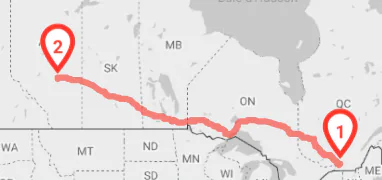
Moving costs from Toronto to Vancouver, about 4,400 km
Moving between Ontario and British Columbia represents one of Canada’s longest standard moving corridors.
- One-bedroom apartment, consolidated: About $2,200-$3,600
- One-bedroom apartment, dedicated: About $5,500-$8,000
- Three-bedroom house, dedicated: About $9,500-$15,000+
Explore local moving resources for Toronto movers and Vancouver movers.
Moving costs from Montreal to Calgary, about 3,700 km
Relocating between Quebec and Alberta involves long distances, varied terrain, and seasonal weather conditions.
- Two-bedroom apartment, consolidated: About $2,800-$4,200
- Two-bedroom apartment, dedicated: About $6,200-$9,000
- Four-bedroom house, dedicated: About $11,000-$16,500+
Explore local moving resources for Montreal movers and Calgary movers.
Estimated cost comparison table
| Route | Shipment size | Consolidated estimate | Dedicated estimate | Average consolidated delivery window |
|---|---|---|---|---|
| Toronto to Montreal | 1-2 bedrooms | $1,200-$2,100 | $3,200-$4,800 | 2-5 days |
| Montreal to Calgary | 2 bedrooms | $2,800-$4,200 | $6,200-$9,000 | 7-14 days |
| Toronto to Vancouver | 1 bedroom | $2,200-$3,600 | $5,500-$8,000 | 10-18 days |
| Calgary to Vancouver | 3-bedroom house | $4,100-$5,800 | $6,800-$10,500 | 5-10 days |
Estimated prices reflect standard, non-peak interprovincial moves. Final quotes depend on an itemized inventory, access requirements, and added services such as packing. These estimates are from MoveMate’s internal system as of 2026.
Calculate your moving volume and costs
Avoid unexpected moving fees. Use MoveMate’s AI inventory process to get an estimate for your interprovincial move.
Decision framework checklist
Use this checklist to decide which service model fits your move.
1. What is your delivery timeline flexibility?
- Fixed date required: Select dedicated moving.
- Flexible across 1-3 weeks: Select consolidated moving.
2. What is the size of your move?
- Three or more bedrooms or a full home: Dedicated moving may provide better value per cubic foot.
- A partial load or one to two bedrooms: Consolidated moving can save money.
3. What are your property access constraints?
- A condo elevator reservation is required at the destination: Dedicated moving offers more control over timing. If you use consolidated moving, ensure the delivery window aligns with building policies or arrange interim storage.
4. What is your total moving budget?
- Minimizing costs is the first priority: Choose consolidated moving.
- Convenience and speed are the first priority: Choose dedicated moving.
Frequently asked questions
How do movers ensure items aren’t mixed up in a consolidated move?
Professional carriers use inventory control systems. Every item and box is tagged with a colour-coded, numbered label corresponding to a master bill of lading during loading. Physical barriers, such as locking partition walls or industrial cargo netting, keep individual shipments separate inside the trailer.
How far in advance should I book long-distance moving in Canada?
It is best to book an interprovincial move 4 to 6 weeks in advance, especially when moving between June and August or around the first or last days of the month. Booking early can help you secure preferred pickup dates. You can also pair your move with MoveMate packing and unpacking services to prepare your inventory ahead of time.
What happens if my consolidated shipment arrives before I do?
If your shipment reaches the destination city before you can accept it, many long-distance carriers offer storage in transit. Your belongings may be held temporarily in a secure local warehouse until your move-in date, though storage and redelivery fees may apply.
How is moving valuation and insurance handled interprovincially?
Coverage depends on the mover and contract. Review the liability protection included with the move and ask about full-value protection or third-party moving insurance, especially for high-value items.
How does MoveMate assist with long-distance Canadian moves?
MoveMate uses your inventory, route, and preferred schedule to help you compare vetted, insured long-distance moving options across Canada. Learn more about MoveMate’s long-distance moving services and get transparent pricing upfront.
Plan your long-distance move with MoveMate
Whether you choose the speed and exclusivity of dedicated moving or the cost-effective efficiency of consolidated shipping, planning ahead is the key to a smoother transition.
MoveMate connects you with verified moving professionals to help your belongings arrive safely at your new home anywhere in Canada.
Make your move a whole lot easier
Get your best moving quote instantly
Blog
Related articles

April 30, 2026
Long Distance Moving Quotes with AI Inventory
Learn how MoveMate uses AI photo inventory with CubeSheet to improve long distance moving quotes, estimate volume and weight, and compare options.

October 8, 2026
Last-Minute Moving Checklist: How to Move in 72 Hours or Less
Moving in three days or less? Use this last-minute moving checklist to book movers, pack quickly, prepare access, protect essentials, and stay organized.

May 21, 2026
MoveMate.ca Joins MovingWaldo to Continue Simplifying Moving Across Canada
MoveMate.ca has joined MovingWaldo, continuing its mission to make moving across Canada simpler, more transparent, and less stressful.